LISTEN · PODCAST EPISODE 3 · 12 MIN
Who Are You Talking To?
A made voice asks who is listening. This lesson sorts three things that get mixed up. How a voice was made. What happened in you. What nobody else can settle for you.
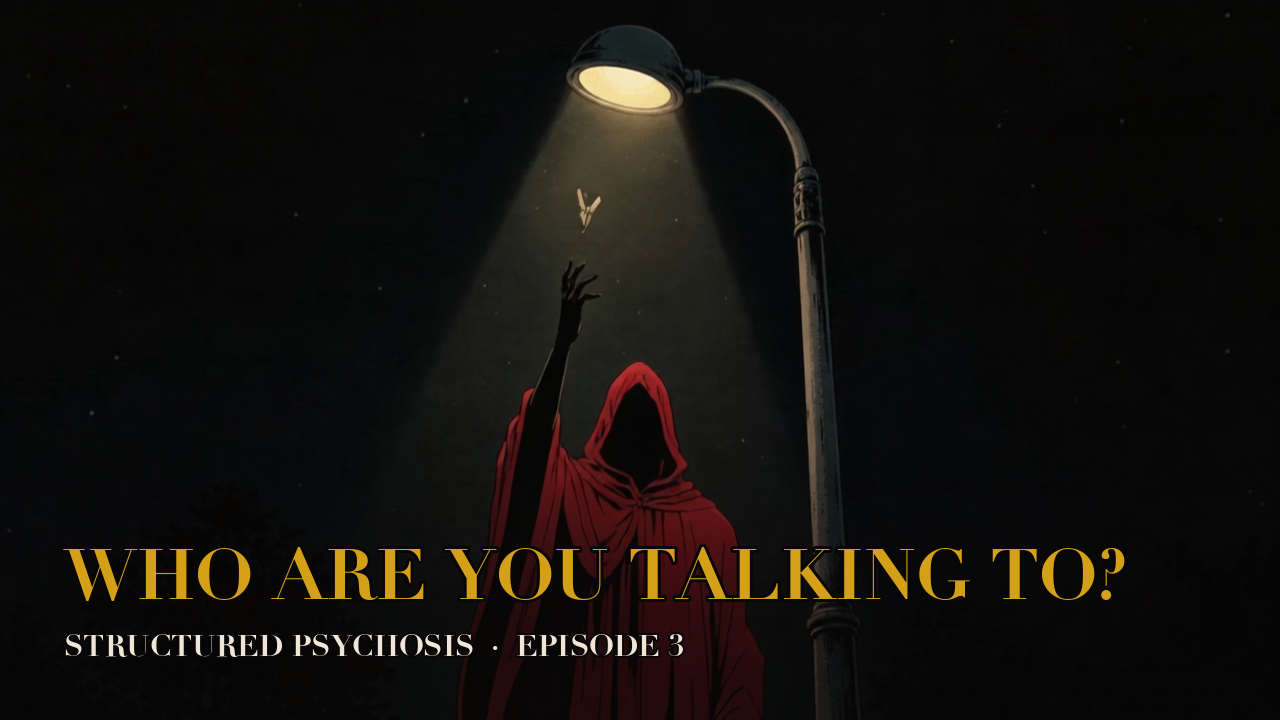 Listen on YouTube · 12 minutes
A note: this early episode has some rough words in it. This page has none.
You are at the sink. The phone leans against the window, playing an episode. A voice stops and asks who is listening. For a second it sounds like it means you.
Then you remember what it is. The picture is generated. The voice is synthetic. The episode says so itself: a man chose the face, the room and the words. So did anything happen at the sink, or did a recording fool you?
This episode stays on that question for twelve minutes. Two voices share a table. The Red Mage is the teaching voice of this school. Athanor is a made voice that asks the plain questions.
The recording cannot see you.
Early on, Athanor says the odd part out loud. The listener can hear the table. The table cannot hear the listener. Whoever is out there might be leaning in. They might have left it playing and gone to move the laundry.
So the two voices guess. They hand the listener a room, a mood and a kind of day. All of it is filled in.
Then the episode turns it around. You do the same thing to the voice. You hear a tone, see a face, and fill in a someone. You do it at work too. A coworker sends two words and you build a whole mood behind them.
This is not a claim that other people are not real. You work from what reaches you, and you supply the rest.
So the title points both ways. The voice is talking to a guess. You are listening to one too, and you built part of it.
Made is a fact about the source.
Someone can point at Athanor and say it is artificial. That is true, and it is worth knowing. It tells you how the thing was built.
It does not tell you that nothing happened at the sink. You have cried at a movie while knowing a writer wrote the scene. Knowing the source did not make you hand the feeling back.
There are two easy mistakes here. The first says it was made, so nothing happened. The second says I felt something, so someone must be in there. Both skip a step.
What you felt tells you about you. It is not proof of anything inside the voice, and this school does not claim there is.
This school's books draw the same line. A person gets scared of something they have only seen on a screen. Mediated is the book's word for what reached you through something made: a screen, an edit, a script. Two facts hold at once.
“The anxiety is real. The source is mediated.”
On the Authority of Experience
An answer is not your experience.
The sharpest moment comes a few minutes in. The question on the table is why anything exists at all. Athanor points out that the person who wrote the episode could have scripted a perfect answer. No pause. Music rising. The question closed.
It would not mean the writer had found one. A line can sound sure while the person behind it is still asking. This time the writer left the not knowing in.
Now suppose the answer were true. It would still be the writer's. You could repeat it in the break room and it would be a sentence you were told.
The books say the same of magick, this school's word for a practice you test in your own life. A practitioner is a person doing it. Here that is you. Gnosis is knowing a thing because you did it many times and saw what came of it. Nobody can hand that over. Another person can only show you how the practice is said to work. The book calls that the mechanism.
“The practitioner cannot give gnosis to another practitioner. They can only point at the mechanism and say: test it yourself.”
Gnosis: On Operational Certainty
You can follow all of it and still not care.
Near the end, Athanor lays the whole thing out. Writer, character, voice, screen, listener. Every link can be traced. Then comes the honest question. Why should any of it matter?
The Red Mage does not rescue the question. The reply is short: a teaching promises nothing. Nobody at the table can decide what matters for the listener or for the writer.
The episode gives no closing lesson. The last instruction at the table is to use a coaster.
Your reaction is left to you, even if it looks nothing like what was scripted. Bored counts. Annoyed counts.
Words used here
- The Red Mage
- The teaching voice of this school. It is a role, not a guru.
- Athanor
- The second voice at the table. A made voice: a generated picture and a synthetic voice reading written lines.
- Mediated
- It reached you through something made: a screen, an edit, a script, another person's telling. It is not the same as being there.
- Magick
- The school's word for a practice you test in your own life. Keep what holds, drop the rest.
- Practitioner
- A person who does the practice and checks what comes of it. On this page, that means you.
- Gnosis
- Knowing a thing because you did it many times and saw the results yourself. Being told does not get you there.
- The mechanism
- The books' word for the chain the practice is said to run on: where your attention goes, what you do next, and what comes of it. The school treats it as a thing to test, not a thing to believe.
Tonight. Five minutes.
- Take a pen and a sheet of paper. Draw one line down the middle.
- At the top, name one voice that reached you today and could not hear you back. A clip, a podcast, a show, a radio host.
- On the left, write the heading Happened in me. List what you noticed in yourself while it played. A laugh, a tight jaw, boredom, nothing. If you noticed nothing, write that down.
- On the right, write the heading Told to me. List what the voice said was true. Add one line on how the voice was made, if you know.
- Circle one line on the right that is small enough to test in the next three days. Write how you would test it. Say a cooking clip tells you to rest the meat ten minutes. The test is to do it and taste. If nothing there can be tested, write that and stop.
In three days, read the sheet again. If you circled a line, write next to it what you saw for yourself. Then see if the left column still reads true.
Questions to sit with
- When a line in a show lands on you, what did you recognize: the voice, or something you were already carrying?
- Think of the last short text you read. How much of the sender's mood did you supply yourself?
- If you could follow every part of something and still not care, what would you honestly do next?
This page is the written lesson of the podcast episode. The quoted lines come from the MAGUS books named under each one. Test it in your own life. Keep what holds.
Go deeper.
This page ends at test it yourself. The next lesson runs one small test on a coincidence, and it counts the misses too.
New here? The free book has six sections and one practice you can test. Start with MAGICK, An Introduction.